


This is not what we meant by “Orwellian nightmare.”
No work of literature is so sacrosanct that it cannot be reimagined or reinterpreted by later artists. That doesn’t mean, however, that taking a politically charged allegorical novel about the Soviet Union under Joseph Stalin and turning it into a toothless, kid-friendly animated movie with fart jokes is a noble or even rational idea.
For some reason, actor and filmmaker Andy Serkis — best known for his motion-capture performances in franchises like The Lord of the Rings and Planet of the Apes — spent nearly 15 years working to bring this extraordinarily misguided version of George Orwell’s 1945 novella Animal Farm to the screen, finally landing with faith-based distributor Angel Studios. It’s hard to envision Serkis’ Animal Farm as a passion project, though, since the result is as soulless as any off-brand animated movie for kids, albeit with famous source material and a suspiciously overqualified voice cast.
By distorting Orwell’s novella to make it theoretically accessible to a modern audience of youngsters, Serkis and screenwriter Nicholas Stoller have drained it of any meaningful message, while also failing to create a movie that kids might actually want to watch. Animal Farm begins with a barnyard-themed rap song that interpolates “Old MacDonald Had a Farm,” and it features plenty of annoying catchphrases. But none of that pandering is a substitute for clever humor or memorable characters or emotional engagement or anything else that makes successful animated movies appealing to viewers of any age.
Serkis and Stoller reorient Orwell’s story around a new character, wide-eyed piglet Lucky (Stranger Things’ Gaten Matarazzo), who serves as the entry point into the tale of farm animals rebelling against their abusive human master. The film eliminates the figure of Old Major, the wise, elderly pig who imparts the tenets of socialism to his fellow animals. Instead, the rebellion occurs spontaneously during the opening credits, with Mr. Jones the farmer barely making an appearance before he gets an udder to the face and is driven off the property.
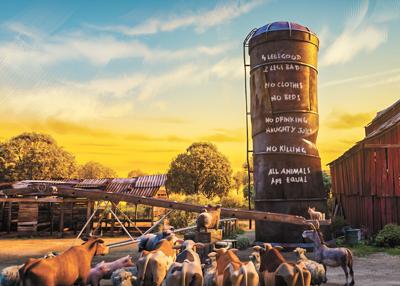
Serkis and Stoller retain the basic structure of Orwell’s story for a little while, setting up the clash between the pigs who vie for control of the farm: the pragmatic but reserved leader Snowball (Laverne Cox) and the charismatic demagogue Napoleon (Seth Rogen). Snowball lays out the well-known rules from the book, including “All animals are equal,” but is soon banished when the greedy Napoleon takes over and begins manipulating the other animals. Every so often, the jokey dialogue screeches to a halt for a bit of Orwellian social commentary, but the serious moments never last, and they’re quickly forgotten for the sake of another stale quip.
While Orwell was specifically criticizing Stalin’s authoritarian perversion of socialist values, Serkis and Stoller aim for a more generic, inoffensive lesson about selfishness and exploitation, as the pigs embrace capitalism and fall under the spell of sinister CEO Freida Pilkington (Glenn Close). The bleakness of Orwell’s story is replaced by a perfunctory happy ending, in which villains are easily vanquished and friendship and good intentions triumph.
Even the literal CIA, which financed the 1954 animated adaptation from British filmmakers John Halas and Joy Batchelor, captured more of the haunted, harrowing tone of Orwell’s work, while adjusting the ending to provide some false rays of hope. Serkis especially stumbles in his depiction of the dedicated workhorse Boxer (Woody Harrelson), whose heartbreaking end is one of the most affecting moments in the book and the 1954 film. Harrelson plays him as dim-witted and easily fooled, and his sacrifice makes no impact, while his dopey-sounding narration only underlines the most obvious aspects of the story.
There are plenty of modern-day authoritarians to attack instead of Stalin, but aside from a couple of times that Napoleon uses the familiar Donald Trump-style “many are saying” sentence construction, nothing in Animal Farm indicates any particular target. The muddled messaging is as bland as the mediocre animation, both staking out a useless middle ground. As Lucky would (unfortunately) say, “What the oink?”