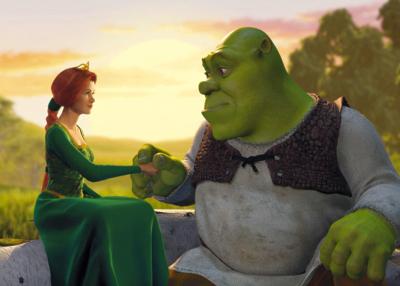
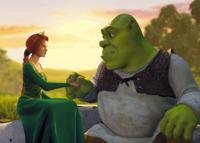


Like an onion or a parfait, there were many layers to Shrek’s bumpy creation.
It’s hard to believe, but Shrek almost wasn’t the box office smash, critically acclaimed, award-winning and widely meme-able sensation we are now celebrating 25 years later. Befitting the title characters’ outsider status, there were many obstacles on Shrek’s trek to glory.
After an acrimonious departure from Walt Disney studios in 1994, executive Jeffrey Katzenberg set his sights on outdoing the House of Mouse by establishing a new decidedly competitive animation division at DreamWorks. After the moderate success of The Prince of Egypt and relative underperformance of Antz (which grossed around $200 million less than the Pixar/Disney insect flick A Bug’s Life that also came out in 1998), Katzenberg cashed in on his post-Mickey enmity with Shrek, an intentionally crude and irreverent rebuke of Disney’s tried-and-true fairy tale recipe. But the path to Shrek’s blockbuster achievement almost never made it out of the proverbial swamp.
The friendly bugle-eared and liver-spotted green ogre first appeared in the pages of New Yorker cartoonist William Steig’s 1990 children’s picture book Shrek!. Rights to an adaptation of the book were initially snatched up by Steven Spielberg, who had designs on casting Bill Murray in the title role and Steve Martin as his exasperating sidekick Donkey, and imagined it as a traditional two-dimensional animated film (a la Spielberg’s collaborations with Don Bluth on An American Tail and The Land Before Time). The famed director failed to crack the project, but retained the rights to Steig’s novel when he co-established Dreamworks with Katzenberg and David Geffen.
After (of all people) Nicolas Cage turned down the titular role, Katzenberg was confident he’d finally found the right man to voice Shrek in comic actor Chris Farley. But Farley’s sudden death in 1997 came late into his recording sessions, and Shrek was once again at an impasse. Enter Farley’s frequent co-star and fellow Saturday Night Live alumnus Mike Myers, who at the time was enjoying a post-Wayne’s World second wind in Hollywood thanks to his sleeper hit Austin Powers: International Man of Mystery. While it’s hard to imagine anyone but Myers in the role now, he was reluctant to agree to the part, calling Shrek “the worst f—ing title I’ve ever heard in my life,” and his reputation as a fussy perfectionist behind the scenes persisted.
Midway through recording his lines, Myers made the abrupt decision to start over from scratch with the now-iconic Scottish brogue instead of the softer Canadian lilt he had been employing. In a 2014 appearance on Marc Maron’s WTF podcast, Myers downplayed the allegations that his creative u-turn cost Dreamworks millions: “Instead of going in for 10 sessions, I went in for 20 sessions. I got paid the same.” (Katzenberg disagrees, quoting the price tag of reanimating facial movements at around $4 million.)
Justifying his reversal, Myers explained that “Scottish people are fantastic at being super happy and then being super mad... and I thought, ‘That’s an ogre.’ And they’re also working people, it’s all about class, Shrek. The fairy tale heroes are upper class, and the ogres are lower class.” He also said that Spielberg sent him a letter later on thanking him for his change-of-heart, which he has framed on the wall of his home.
The drama in the audio booth didn’t end with Farley’s tragic end or Myers’ accent switcheroo. As publicized back in ’97, Janeane Garofalo was cast to portray Princess Fiona, before being replaced by Cameron Diaz. Of the principal cast, only Eddie Murphy as Donkey survived the production tumult.
Not only did Shrek initially sound much different from the omnipresent ogre we know and love today, he also looked remarkably more repulsive during the Farley era of development. Early character designs and an absolutely ghastly animation test are Google-able, but be advised that they are absolute nightmare fuel compared to the relatively anodyne versions we ultimately saw in theaters (think: Sonic the Hedgehog’s initial renderings with garishly human teeth but way worse).
Given that feature-length CGI films were still something of a novelty in the late ’90s, the task of actually animating Shrek was a tall order, made more complicated by its pioneering use of new motion capture technology that predates Andy Serkis’ Gollum in the Lord of the Rings trilogy. And Katzenberg’s subversive passion project was about as popular within the Dreamworks ranks as its lead character was in the kingdom of Far Far Away, so much so that animators who were deemed to have delivered unsatisfactory work on the studio’s more “prestigious” The Prince of Egypt were shunted off to the “gulag” of Shrek. Employees derisively called it “being Shreked.” As one anonymous animator recounted to Nicole Laporte in her book The Men Who Would Be King: An Almost Epic Tale of Moguls, Movies, and a Company Called DreamWorks, “If you failed on Prince of Egypt, you were sent to the dungeons to work on Shrek.”
Despite all of the long hours, exasperated crew, false starts and hold-ups, Shrek eventually raked in nearly $500 million worldwide and won the first-ever Oscar for Best Animated Feature. Now the face of a massive transmedia empire that includes theme park attractions and multiple spinoff films, Shrek got the happily ever after ending it deserved all along.
Shrek returns to theaters May 15 for its 25th anniversary.