
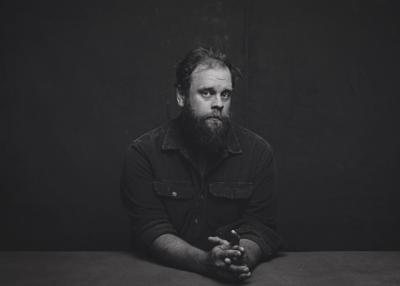



Get lost in Jeffrey Martin’s haunting and poetic folk songs.
Jeffrey Martin hadn’t released an album in over five years when he retreated to the tiny 8-by-10-foot shack he built in the backyard of his Portland home in the winter of 2022. The former high school English teacher turned folk singer-songwriter was only planning on putting together some sparse demos for his fourth LP during the solitary nights with just his voice, a guitar and a couple of microphones.
But there was just one “issue” — those demos sounded really, really good on their own.
After sharing them with his label, Fluff and Gravy Records, the decision was made to simply release the collection of meticulously written somber songs in their ultra-minimalist demo form, with the only extra details coming via some subtle electric guitar embellishments on three tracks. Thank God We Left the Garden was released in November 2023 and was instantly hailed as a monumental breakthrough record for Martin. In a musical culture that always claims to value authenticity — especially in the digital hellscape of facades that so many are blindly rushing to create — Martin delivered something unwaveringly genuine.
“The songs on that Garden record, as I was writing them, they felt like they wanted to be present in that way. Just kind of very real,” Martin says. “I enjoy a lot of music that’s heavily produced, [it’s] just for this project and for the live record, too, I felt like I really wanted to listen to those songs and have there be no real feeling of separation between the real-life thing sitting and experiencing music and hearing the tunes.”
The simply recorded songs on Thank God We Left the Garden hang heavy with the Pacific Northwest folk sound, atmospherically evoking fog drifting among towering Oregon pines as dusk begins to fade. The slow-spoken Martin always takes his time delivering his poetic lyrics, giving a deliberate weight to his reflections on existentialism (“Garden”), queer pain (“Red Station Wagon”) and the beauty of the world carrying on without you after you die (“There Is a Treasure”).
Lyrics have always led the way for Martin, who matter-of-factly states he only ever learned enough guitar to be able to write songs, rather than chasing anything close to mastery of the instrument. And those lyrics that he pens tend to be on the sad side just because there’s more material to mine from those headspaces.
“I’ve always been drawn to writing characters in songs,” Martin says. “And I just think it’s the same in songs as it is in films or books or — the more complicated a character is, the more I’m interested in them. There are only so many levels of complexity in happiness.”
While Martin might not test the limits of his guitar, the time alone in his shack making Thank God We Left the Garden did allow him to more fully explore his other instrument: his voice.
“For as simple as those songs are musically, there’s a lot of nuance that I got to explore vocally that I haven’t explored on other records because I was singing so close. And that was really what I was chasing, this space to play in these simple forms vocally, but to be recording so closely and simply that I could just do a lot with throwing my voice around or mouth shapes or like where my head was to the microphone — stuff that I wasn’t as attentive to on previous records,” Martin says. “I loved the sound that I was getting, but there was a part of me the whole time I was making it that felt like... people often ask like, when am I going to tour with or when am I going to make a full-blown band. And here I am going the other way. [laughs]”
While Martin’s influences range from the heavy-hitters of folk (Bob Dylan, Neil Young, John Prine) to the ’90s Northeast folk scene (John Gorka, etc.) to early Wilco albums, perhaps the musician who most influenced Thank God We Left the Garden was the one he spends the most time around.
“My partner Anna Tivel — who’s a brilliant songwriter — she has a really quiet singing voice. And I think it took me awhile to realize that the power of a song has really very little relation to the volume of the song, even though we’re all tricked into thinking that it does,” Martin says. “And I think I was trying to explore that too on the Garden record. There were a lot of times where I was recording those songs in the shack, and I’d get a take that I thought was great, and I’d listen back and realize, ‘No, you can actually sing that softer and more powerfully.’”
If you want to know what Martin’s May 8 concert at The District will sound like before going, you’re in luck. In February, the singer-songwriter released Alive July 25, 2025, which is one of the most unfiltered live albums you’re likely to find. It almost feels like an audio documentary, where you can clearly make out the clanking of bottles and glasses in the background and even mistakes. On “Garden (Attempt),” Martin starts things off normally before humorously improving a few lines about how he has to stop singing because he has something stuck in his throat, then cutting off the tune to give it a proper second go.
“I really wanted to think about it almost like a field recording,” Martin says of Alive. “I told Sam Weber, who captured the show, ‘I just want to be whatever we do in the room to get captured.’ It felt like a big kind of pushback against [how things are going] — this is just a very real thing. In the mixing of that record, there were a lot of questions about, ‘How much to leave in there? Where should the cuts be?’ And that was a hard thing, because if I had my way, it would have been a single track. But obviously there need to be some breaks.”
That sense of quiet intimacy found on Thank God We Left the Garden also has the unintended benefit of curating more attentive audiences. When there’s not a full band making noise on the stage and the songs themselves often feel like hushed emotional murmurs, people shut up and focus in.
“It’s just such a great thing to discover that there are a lot of people out there who are listening. Like really closely,” Martin says. “And the people coming to shows now that want to hear the songs from that record, they have stories about where those songs connect to their lives, and that’s really meaningful to me.”
Finding success by breaking the norms has also freed Martin up to explore new horizons in the things he’s currently writing, ones that might not fit the standard folk song template. He’s now more emboldened to lean into the weirdness of “a lot less linear” folk to chase the sound he truly wants.
“In a really exciting way, I feel like I’m moving right now. What I thought was like an established paradigm of sound in my mind is not there like I thought it was,” Martin says. “I appreciate that people love my older songs… but there’s a part of me now that feels like I don’t want to be contained to those forms forever.”
“I guess the big thing is it took me a while to realize, and maybe a lot of songwriters fall into this same trap, you can write a song that works and has lyrics that people like and it has a verse and a chorus and all the shit, but it doesn’t mean that you like what you made,” Martin continues. “And I think that for a while I wrote songs that I was proud of lyrically, but I didn’t like them musically. And now I’m really trying just to explore the joy piece. Does this bring me joy musically?”
Perhaps that’s just an element of spring cleaning in Jeffrey Martin’s minimalist musical journey. Even experts at forlorn songwriting need to Marie Kondo their creativity sometimes.
Jeffrey Martin, Hannah Siglin • Fri, May 8 at 9 pm • $31 • 21+ • The District • 916 W. First Ave. • sp.knittingfactory.com