
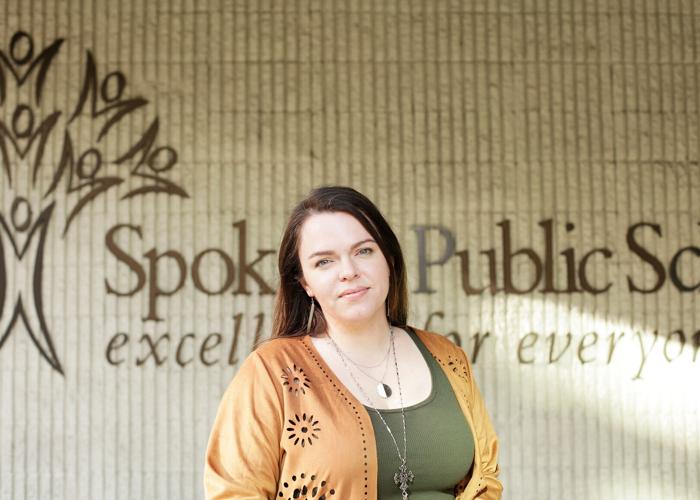



Rebekah Marie Lawson, a truancy administrator at SPS, knows how challenging it can be for students to engage in their education.
To overcome a projected multibillion-dollar deficit in the 2025-27 biennium and pass a budget, Washington state lawmakers worked the angles in 2025, from new revenue streams to sweeping spending cuts.
Included in the budget signed by Gov. Bob Ferguson was a deep slash to juvenile court funding. According to Spokane County Juvenile Court Director Tori Peterson, in fiscal 2025 (July 1, 2024, to June 30, 2025), the Spokane court received $1.3 million from the state, but for fiscal 2026 that funding dropped to $425,000.
That cut has largely impacted the court’s ability to handle truancy petitions, which state law requires districts to file if a student has seven unexcused absences in a month or 15 in a year.
Recognizing that truancy is often a symptom of other issues — such as a lack of reliable transportation, mental health issues, substance abuse, housing insecurity or even general disinterest in the traditional high school curriculum — Peterson says the loss of case managers who would visit students and families at home to identify what’s preventing them from regular attendance has been significant.
“We lost three case managers, and that has had the greatest impact on our community and our kids,” Peterson says. “We still have the court process, which is important. It brings the kids here.”
Between July 2024 and February 2025, the county juvenile court received 1,282 truancy petitions. In the same time period a year later (state funding cuts went into effect in July 2025), Peterson says the court only received 688 petitions.
“Historically, we’ve had an amazing partnership with Spokane County Juvenile Court and the truancy case managers,” says Rebekah Marie Lawson, Spokane Public Schools’ top truancy administrator. “I can’t tell you how valuable they were and how much we’ve been missing them this year, I desperately want [the court] to be re-funded so that [case managers] can come back into this process.”
The Legislature’s recently approved supplemental budget, which Ferguson has yet to sign into law, allocates an additional $3 million in fiscal 2027 for the state’s juvenile court administrators who provide services to at-risk and truant youth.
Despite the reductions at juvenile court, Lawson says she’s dedicated to following state truancy laws while supporting students within Spokane County’s largest district who may be struggling with attendance.
IN WRITING
Passed by the Legislature in 1995, Washington’s truancy law “Becca’s Bill” is named for Rebecca Hedman, a 13-year-old runaway who was murdered and found near the Spokane River in 1993. Her parents, along with the parents of other teens with similar stories, argued that the state was not adequately protecting their children, the Seattle Times reported in ’95. Originally from Tacoma, Hedman did not attend public school, spending most of her time in drug counseling and rehab centers.
To protect at-risk youths, Becca’s Bill created three juvenile court petitions.
At-Risk Youth petitions, filed by parents, seek judicial assistance when kids under 18 are absent from home for more than three days without permission, participate in dangerous behaviors and/or struggle with substance use. Courts can mandate that a kid must attend school, remain at home after school and stop any illegal activity.
Children in Need of Services, or CHINS, petitions are filed by minors, parents or the state Department of Children, Youth and Families to seek an out-of-home placement to “repair family relationships and ensure child safety” amid abuse or unhealthy home dynamics.
The third, and according to Peterson the most common, petition filed is for truancy. State law requires all children between the ages of 8 and 18 regularly attend public school, private school or approved home school programs. Students who have seven unexcused absences in a month or 15 in a school year are considered truant, and districts are required to submit a petition to juvenile court.
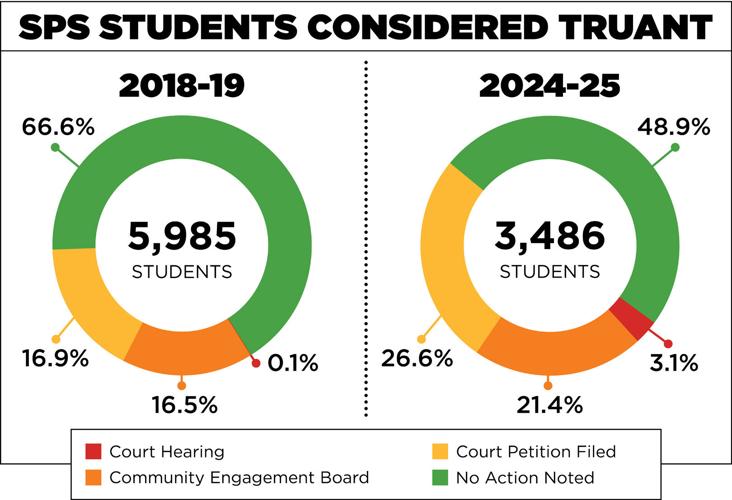
Under these standards, 3,486 Spokane Public Schools students (11.7% of the district’s student population) were considered truant in the 2024-25 school year, according to data collected by the state Office of Superintendent of Public Instruction. Of those, 1,228 students had truancy petitions submitted to juvenile court.
“I’m only 35% compliant,” Lawson says.
Yet SPS is leaps and bounds ahead of other districts that don’t have the funds to hire a full-time administrator like Lawson. Spokane Public Schools’ truancy petitions accounted for nearly 20% of the state’s 6,232 petitions filed last school year.
“If a school has a Becca team, they don’t just do that work,” Lawson says. “Very frequently, Becca is the add-on… while it’s my full-time job, it’s not their full-time job.”
According to Lawson, SPS does not receive dedicated funding to support the truancy compliance work of 150 employees in the district who focus on that as part of their jobs.
Of the 1,228 students with truancy petitions filed last year, 986 were referred to Community Engagement Boards, previously referred to as Community Truancy Boards. These required meetings usually bring the student together with their parents, teachers, staff and community members to set expectations for future attendance while working to overcome any barriers to attendance.
When a student improves after the community board meeting, the district can dismiss the truancy petition. But if a student has failed to reengage in school, the district can seek a court order requiring the student to return to class. During the 2024-25 year, 142 SPS students received juvenile court hearings and orders to return to class. There were no reports of students failing to comply with their court order.
“There’s still some thinking out there that there is still the school-to-prison pipeline. That was dismantled long ago with all of our system reform, where we have gone away from punitive measures to this is all about early intervention,” Peterson explains, noting that students aren’t detained for truancy anymore.
Back in the 2018-19 school year — before the Legislature passed House Bill 5290 barring juvenile detention for noncriminal offenses as of July 2021 — only eight out of 5,985 truant SPS students went to court, and none of them faced juvenile detention.

Fewer Spokane students are truant as more unexcused absences are now required to hit that mark. However, more end up in juvenile court hearings.
BECCA WITH BEKAH
Before Lawson began working with the school district, she worked at Spokane County Juvenile Court. Though she didn’t handle truancy cases, she was familiar with how they worked.
“When the opportunity came to work with [SPS] students before they got to juvenile court through the RISE program, which stands for ‘Restorative interventions for suspensions and exclusions,’ I was like ‘Yes! I totally want to apply,’” she says.
Lawson understands where students are often coming from because she, too, struggled in a cookie-cutter K-12 environment. She didn’t attend public school until fifth grade, and she struggled socially due to the rigidity of basically having six bosses each day. Later, when she got more say in how her education looked, school didn’t seem so bad.
“Running Start changed my life because I was able to fully participate academically, but I was provided a level of respect and understanding that I don’t know I adequately received while in a high school setting,” Lawson says, referring to Washington’s program that enables high schoolers to enroll in college classes.
As the district’s Becca manager, Lawson took a more active role in communicating attendance rules. She started holding office hours, which she calls “Becca With Bekah,” to ensure staff at each school are on the same page.
“When I started doing that it really changed the way we connected to the work, because suddenly I had all the school Becca teams connecting… they were all getting the same information, and I was there to answer all their questions,” she says. “Truancy is not separate from attendance. Our goals and our messaging is that we want children in school. We want them to access their education. If there are barriers, we want to find a way to navigate around those barriers or remove them.”
Now finishing her second year, Lawson oversees this work at all 58 schools and is brought into conversations when a student is having what she calls a “navigation issue.” Part of Lawson’s job in these moments is to connect students with tangible alternatives — such as GED programs, Running Start, trade school or early graduation — that will help improve attendance while keeping them engaged in their education.
REFORMS OVERDUE?
While Becca’s Bill was created with good intentions, some feel it doesn’t adequately account for students with disabilities or special needs.
When Caitlin LaJoie’s son with autism was unable to get the services he needed at his very small Spokane County school district, she made the decision to keep him home from school.
“What else can you do?” LaJoie says. “They don’t have a special education teacher. They don’t have a psychologist that’s on-site. … It was a terrible situation for everyone.”
After she began keeping her son home from school, an administrator called to say the boy needed to attend school because his absences would trigger Becca’s Bill. Though the school district never filed a truancy petition, LaJoie says it can become a vicious cycle for students like her son.
“We can’t access school because the supports that we need to access it are not present, so we stay home,” she says, “and then we are told, ‘Now you’re in trouble because you’re staying home.’”
LaJoie’s son now attends a school within Spokane Public Schools and has yet to have any problems with his attendance triggering truancy warnings. While she agrees with the state’s law, she thinks there could be more communication between schools and parents.
“When my son was not able to attend school, he was in private counseling and [occupational therapy] weekly and seeing a psych provider monthly,” she says via email. “Since [the] original intent of the Becca Bill was to account for children’s whereabouts, it seems to me a useful tool would be for schools to simply request verification that the child is accessing services and seeing providers who can account for their safety and well-being.”
Over the last two years, House Bill 2044 floated changes to Becca’s Bill. The legislation co-sponsored by Rep. Timm Ormsby, a Spokane Democrat, would’ve no longer required school districts to file truancy petitions, instead having them create attendance agreements with students.
On April 5, 2025, a staff member told the House Appropriations Committee that the bill could save the state an estimated $14.5 million in the current biennium and $16 million in the following budget cycle.
However, Lawson says SPS already implements attendance agreements before the court ever gets involved.
“When a student hits three unexcused absences in 30 days, a letter goes out and the attendance agreement also goes out with it,” she says.
Though the bill passed the House last year, it didn’t move forward during this year’s legislative session.
Peterson, of Spokane County Juvenile Court, says she opposed the bill because it went against the original intent of Becca’s Bill: to keep track of at-risk youths.
“Something is better than nothing,” Peterson says. “Our ideal is to have that [petition] obligation, so we get eyes on these kids. If you don’t have eyes on kids, you’re gonna lose them, and then you’re gonna have more Rebecca Hedmans.”