
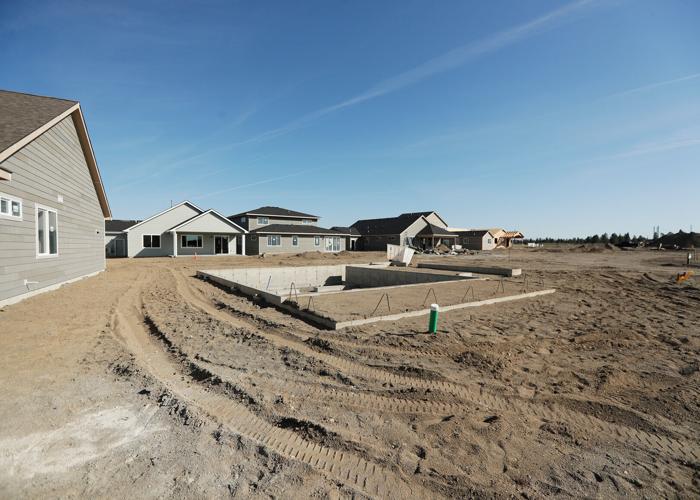
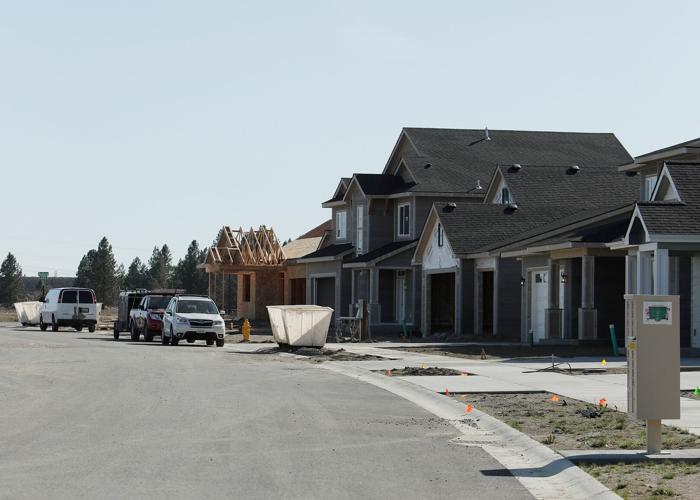


Construction is underway at Greenstone Homes’ Mead Works in north Spokane, an example of denser neighborhood development that’s possible in urban growth areas.
While many parts of the somewhat wonky-sounding “comprehensive plan” update for Spokane County have been in the works for months (in some cases, years), efforts are ramping up in earnest, with more chances for members of the public to weigh in starting over the next few weeks.
In addition to updating the state-required plan, which provides a vision for growth over the next 20 years, the county (and city of Spokane and others in the state’s update “class” of 2026) will be updating its actual rules and regulations that dictate how projects must be done.
Elements that have been discussed in part so far range from the county’s “critical areas ordinance” — mapping where aquifers, wetlands, fish and other wildlife are, and how to protect them from negative development impacts through preservation, riparian buffers and more — a “land use analysis” of what is already developed and what could handle more homes or businesses, and other chapters that consultants are helping the county update using current state law and best scientific practices.
As planners dig in on documents that guide how the area can grow, upcoming discussions might pique the interest of people outside of developer/planner circles.
For instance, do you think farmers should be allowed to offer “agritourism” on their properties to supplement their income by hosting weddings, harvest events and more?
Separately, do you think developers in rural areas and those on the edges of cities should be required to create a specific number of parking spaces for every housing unit they build, or do you think it’s better to let the market conditions guide those decisions and remove those requirements in areas with access to public transit, as the city of Spokane has largely done?
These real examples from recent discussions between the Spokane County Planning Commission and county planning staff offer a tiny taste of the goals and regulatory changes that are likely to be decided this year under the once-per-decade update required by the state’s Growth Management Act.
First passed in 1990, Washington’s Growth Management Act requires planning departments and elected officials to intentionally prepare for people to move to their area and anticipate the needs they will have (such as water, sewer, fire service, schools and more), while preventing sprawl and excessive burdens on the environment.
“The legislature finds that uncoordinated and unplanned growth, together with a lack of common goals expressing the public’s interest in the conservation and the wise use of our lands, pose a threat to the environment, sustainable economic development, and the health, safety, and high quality of life enjoyed by residents of this state,” state lawmakers wrote in the act’s introduction.
During last week’s regular meeting on April 9, the county’s Planning Commission started looking at a draft of the chapter that guides the vision for housing and received an update on the county’s critical areas ordinance.
Once the Planning Commission makes recommendations, the Spokane County Board of Commissioners will have the chance to review the updates, request changes if needed, and ultimately decide whether to approve each portion of the plan and any associated updates to county development rules. The final version of the updated comprehensive plan is expected to be approved in mid-December.

NEW ELEMENTS
During this update, the county is working to ensure its plan will represent regional goals and priorities, and not just focus on how specific corners of the county should be developed, explains Scott Chesney, Spokane County’s planning director.
“From my perspective, our county plan will be an entire county plan, it will not be just a plan for the unincorporated parts of Spokane County,” Chesney says. “The county plan will reflect how important it is that the city of Spokane, and downtown Spokane, are working and planning in concert with the county, so we’re putting new industry, for example, that can go where it needs to go, rather than having communities fighting over which side of a line it should go on.”
The county also offered small cities and towns (typically without extensive planning staff) the chance to pay a small share to help hire and benefit from the consultants the county has working on its update, which five towns on the Palouse opted to do. The county’s plan will include summaries of all the cities and towns, and in some places acknowledge the close relationship with neighboring Kootenai County, even though Idaho has drastically different development regulations, Chesney says.
In addition to updating chapters that were included in the previous plan, agencies across the state are now also required to write a chapter that covers climate resiliency, and specifically ensure that regulations don’t prevent affordable housing from actually being built, Chesney says.
“In the past, it was pretty simple: It said counties and cities should make accommodations for affordable housing,” Chesney says.
Under updates the Washington Legislature made to the Growth Management Act, cities and counties must now plan for ways to support and build housing that’s affordable for people within specific income bands — 0% to 30% of the area median income, or AMI, 30% to 50% of AMI, 50% to 80% of AMI and so on.
That could be a challenge for counties in particular, which are often planning for growth along the outskirts of urban cities (typically within what’s referred to as the “urban growth area” under this type of planning) and in rural areas, Chesney says.
The county might tackle the requirement by looking at some updates to its zoning regulations that could encourage more of a neighborhood or “village” type feel for developments that historically would’ve been only subdivisions of single-family homes, he says.
An example of one such area that’s already under development within the urban growth boundaries is Mead Works, a Greenstone project neighboring the north Costco and Newport Highway that will ultimately include various levels of housing (single-family, multifamily and senior living) alongside retail, park land and other amenities that will make the north Spokane community more liveable, walkable and diverse.
Another way to ensure more affordable housing is built is to either require that a specific percentage of units within a development are affordable or require the developer to pay an equivalent fee into a trust fund of some kind, which would then pay for affordable units to be built elsewhere within the county, Chesney says.
Those housing incentive elements are all still being worked out.
“It’s a chapter in progress, to be sure,” Chesney says.
According to the state Office of Financial Management, Spokane County is expected to grow by more than 100,000 people by 2046, with about 35,000 of those people anticipated to move into the unincorporated portions of the county, mostly within the urban growth boundaries.
At the Planning Commission meeting last Thursday, commission member Logan Camporeale suggested the county consider requesting an expanded version of the state’s “parking to people” sales tax incentive to encourage developers to turn parking lots into housing, which cities like Spokane can promote and make use of, but isn’t really available for counties.
“In the northern urban growth area it wouldn’t be available,” Camporeale said, but maybe “county legislative advocates could pressure the state to expand that incentive to include all urban growth area or something like that.”
ENVIRONMENTAL IMPACTS
By the end of April, the county expects to have its draft environmental impact statement for the plan update ready, with various options the county could take as it moves toward approving its comprehensive plan.
These types of environmental analyses typically look at three or more options: the no-action alternative (where would those 100,000 people go if no rules were changed?) and two other alternatives considering various changes to regulations.
Ultimately, the changes that are made will likely fall somewhere in the middle of those alternatives, with a focus on filling in land that’s available for development, while fine-tuning where that development might happen, Chesney says.
He notes the county’s collective acres available to be developed under the “urban growth area” designation are actually likely to decrease from the current total of about 1,000 acres, as much of the land set aside for that type of growth has seen little development over the last three decades. Instead, Chesney says this is an opportunity to explore where development is more likely to occur and where there are the most opportunities to link people with existing public transit and services, such as the north metro area and on the West Plains, which could each benefit from a higher-density neighborhood feel.
Within urban growth areas, land is allowed to be developed more densely, similar to cities, whereas rural areas are required to remain more open.
“The urban growth area is going to be quote, unquote ‘rightsized’ to better fit our development patterns for the next five, 10 and 20 years,” Chesney says. “That means it’ll be smaller and there are areas where those borders and boundaries will probably change to better fit those patterns of growth.”
UPCOMING MEETINGS
On Thursday, April 30, the Spokane County Planning Commission will hold its meeting later than usual, starting at 4:30 pm in the hearing room inside the Public Works building at 1026 W. Broadway Ave. in hopes that more members of the public might be able to attend. (Typically those meetings are held at 9 am, when working adults have a difficult time attending, a fact that’s been criticized by community members at recent meetings.)
The meeting will specifically allow the commission the chance to discuss state agency feedback on the county’s critical areas ordinance, and to take public comments on the comprehensive plan chapters on rural lands and economic development.
Over the month of May, it’s likely that the county will host meetings out in the community to discuss the environmental impact statement alternatives, Chesney says.
Then, on May 28 (meeting time yet to be determined), there will likely be a public hearing on the critical areas ordinance before the Planning Commission, as well as a discussion of the land use chapter, which is where things will really start to come together as far as plans for development for the next 20 years, Chesney says.
“I’ve discovered in my time in planning that zoning can be a little bit dry to a lot of people. We don’t generally have standing-room-only meetings for a lot of these issues, but that said, there are some important dates coming up,” Chesney says. “We are changing, fairly significantly, the development regs to implement these new planning concepts and ideas.”